
Artificial intelligence is rapidly becoming part of the enterprise operating environment. The question for most organizations is no longer whether AI belongs in the business. It is where it should be used, how quickly it should be scaled and what kind of value it should be expected to create.
At Murkez, we believe the distinction is fundamental: using AI is a technology decision. Creating sustained value from AI is an operating-model decision.
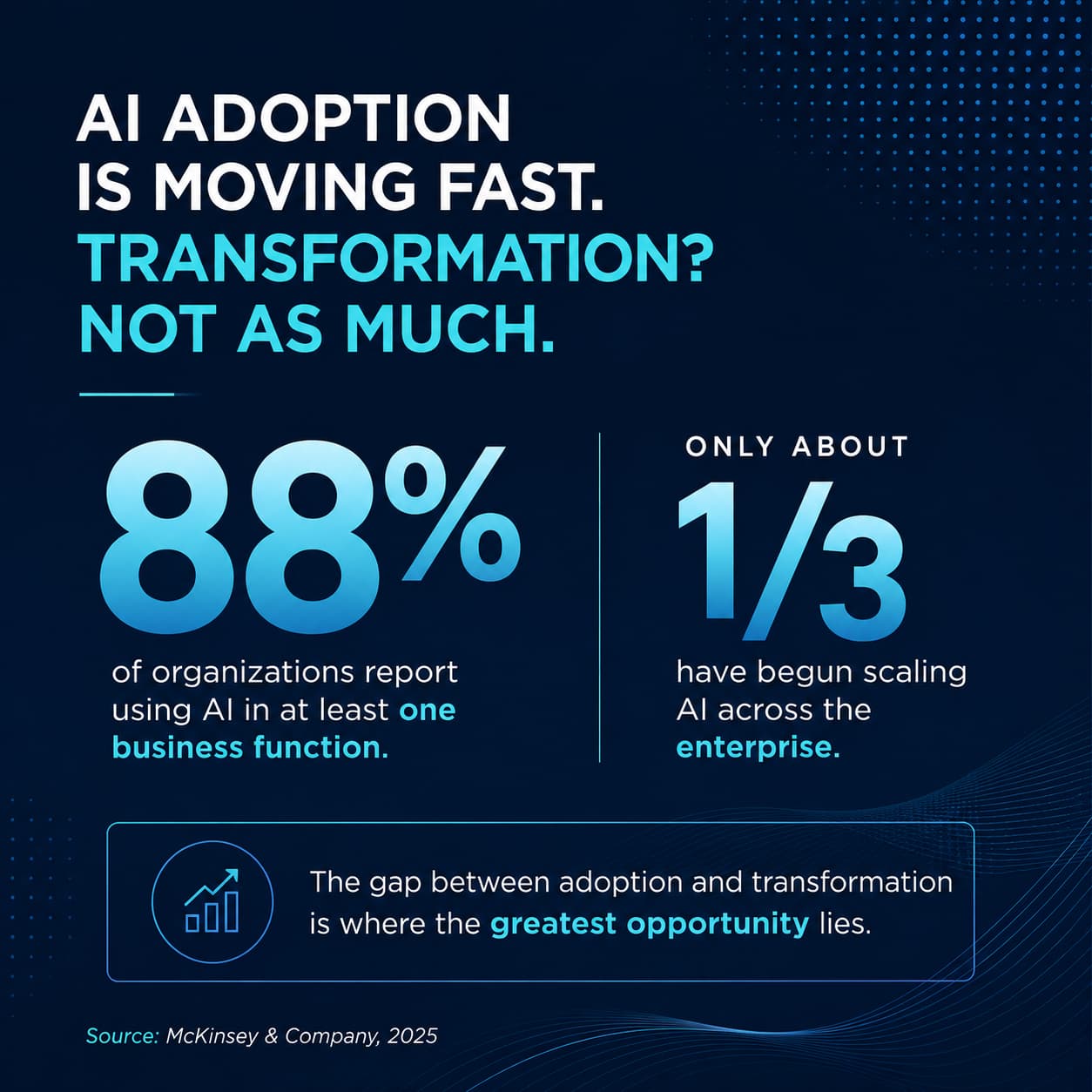
The adoption numbers make the gap visible. In McKinsey’s 2025 global survey, 88% of respondents said their organizations were regularly using AI in at least one business function, compared with 78% a year earlier. Yet only about one-third reported that their organizations had begun scaling AI programs across the enterprise (McKinsey & Company).
That gap matters more than the adoption number itself. A company can deploy copilots, launch pilots and automate hundreds of tasks while still operating through fragmented workflows, unnecessary approvals, inconsistent data and unclear decision rights. AI can be present across the organization without becoming part of the way the organization actually operates.
As AI capability becomes easier to access, simply possessing the technology will become less distinctive. The advantage will move toward organizations that can absorb it into the way they work, make decisions and improve performance.
The next AI problem is not adoption. It is absorption.
We use the term AI absorption to describe the point at which AI stops being an additional tool and starts changing the operating model. Adoption tells us whether AI is present. Absorption tells us whether workflows, roles, decisions, management practices and performance measures have changed because of it.
The distinction is practical. Adoption may mean licenses purchased, pilots launched, employees experimenting or individual tasks automated. Absorption is visible when work is reorganized around new capabilities: information reaches the right person earlier, routine decisions move closer to real time, roles shift toward higher-value judgment, and managers begin measuring outcomes that were previously difficult to see.
A useful way to think about absorption is as the conversion layer between technological capability and business performance. AI may create a new capability, but the organization still has to convert that capability into changed behavior, changed process economics and ultimately changed outcomes. If that conversion does not happen, AI remains an overlay on the existing operating model.
Boston Consulting Group found that only 26% of companies in its research had developed the capabilities required to move beyond proofs of concept and generate tangible value from AI. Just 4% had developed cutting-edge capabilities and were consistently creating significant value (BCG).
The emerging divide is not simply between companies that use AI and those that do not. It is between organizations that can absorb a new capability into their operating model and those that layer it onto the old one. That is why AI absorption should be treated as an organizational capability in its own right, not as the final stage of technology deployment.
Absorption can also be observed through management behavior. When AI is genuinely embedded, leaders stop asking only how many employees are using a tool and begin asking different questions: which decisions have improved, which handoffs have disappeared, which exceptions now require less effort, and where released capacity has been redeployed. Those are signs that AI has moved beyond usage and started changing the operating system of the business.
A faster task is not the same as a better operation
Much of the first wave of generative AI has focused on individual productivity. An employee can summarize a report faster, retrieve information more efficiently, prepare a first draft in seconds or receive immediate assistance with analysis. These gains are useful, but businesses do not operate as collections of isolated tasks. They operate as connected systems of work.
Consider a customer request that moves through several departments before resolution. AI may reduce one analytical step from twenty minutes to two. On paper, that task is 90% faster. The customer may see almost no improvement if the request still waits for approval, moves through multiple queues, requires information from disconnected systems or has to be reworked because ownership is unclear.
The real constraint may not be work time at all. It may be wait time. In many processes, a relatively small amount of active work is surrounded by hours or days of waiting for information, decisions, approvals or the next available person. Improving one task can create an impressive productivity statistic while leaving total cycle time largely unchanged.
This is why we view AI productivity across three connected levels: task efficiency, process flow and business measurement. Task efficiency asks whether an activity can be completed with less effort. Process flow asks whether work moves through the organization with less friction. Business measurement asks whether those changes improve outcomes that matter, such as throughput, cost, resolution, accuracy or customer experience.
McKinsey’s 2025 research supports the importance of this broader view. Workflow redesign was one of the clearest characteristics associated with stronger AI outcomes, and AI high performers were substantially more likely to fundamentally redesign workflows rather than simply place AI into existing ways of working (McKinsey & Company).
For leaders, hours saved is only the beginning of the business case. If an employee saves five hours each week but their workload, output and service levels remain unchanged, the organization has created theoretical capacity without necessarily converting it into economic value. Deloitte found that while 54% of organizations in its survey were seeking efficiency and productivity improvements from generative AI, only 38% were tracking changes in employee productivity (Deloitte).
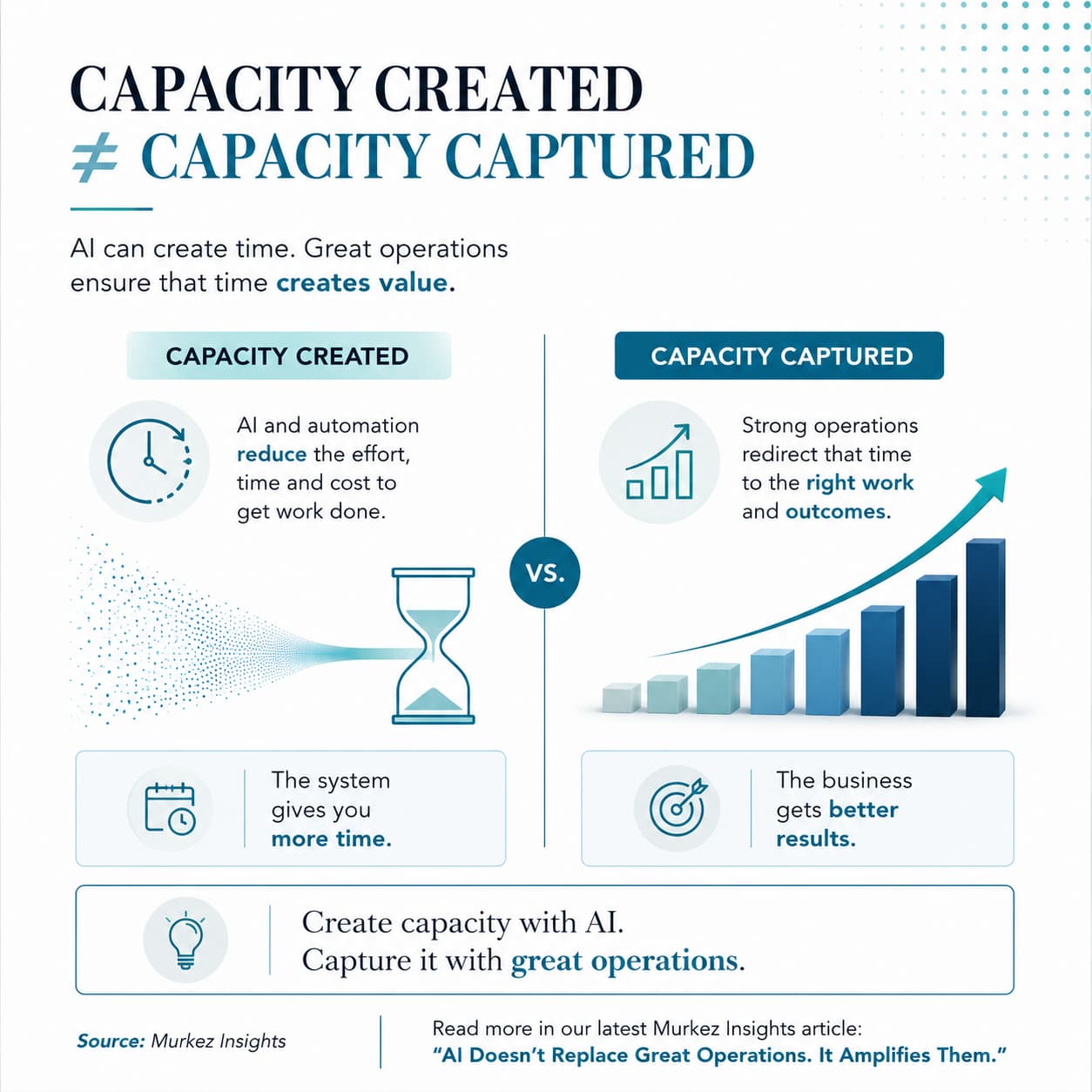
At Murkez, we distinguish between capacity created and capacity captured. AI creates capacity when it reduces the effort required to perform work. The organization captures that capacity when it uses the released time to process more transactions, improve service, reduce overtime, absorb growth without equivalent headcount growth or redirect people toward higher-value activity.
The strongest AI productivity programs connect all three levels. They improve the task, remove friction from the process and establish a clear mechanism for translating released capacity into measurable business performance.
This also changes how AI initiatives should be governed. A project that reports only model accuracy, adoption rates or hours saved is measuring activity rather than operating impact. A stronger scorecard connects technical performance to process performance and then to the business outcome leadership cares about. That linkage makes it easier to decide which initiatives deserve further investment, which need redesign and which should be stopped.
Before automating a process, ask why the process looks that way
Most operational complexity is accumulated rather than deliberately designed. A control is added after an incident. A new system creates another handoff. A department builds a spreadsheet because the central platform cannot provide the information it needs. An approval introduced during a period of rapid growth becomes permanent long after the original reason has disappeared.
Over time, organizations inherit workflows that nobody would design from scratch. AI creates a particular risk in this environment: if the first question is what can be automated, technology can preserve operational decisions that should be challenged instead.
Our preferred sequence is to simplify, standardize and then intelligently automate. Simplification asks whether every step is necessary. Standardization creates consistent rules, ownership and data structures. Automation is introduced only after the organization understands which work should remain, which work should disappear and where technology can change the economics of the process.
An approval process involving four management levels may be easy to accelerate with AI, but the more valuable question is whether four approvals are necessary. AI can reconcile information from disconnected systems, but leadership should still ask why the information is fragmented. AI can classify thousands of exceptions, but management should still understand why the process generates so many exceptions in the first place.
AI is exceptionally good at managing certain forms of complexity. That should not become an excuse to preserve complexity the operating model no longer needs. The discipline to remove unnecessary work before automating it remains one of the simplest ways to protect AI investment from becoming expensive process preservation.
AI readiness is also operations readiness
Much of the discussion around AI readiness focuses on data, infrastructure, governance and security. These remain essential. Gartner reported that 63% of organizations either did not have, or were unsure whether they had, the right data-management practices for AI. It also predicted that through 2026, organizations would abandon 60% of AI projects unsupported by AI-ready data (Gartner).
The operating environment deserves equal attention. An AI-ready operation tends to have characteristics that are valuable even without AI: important processes have identifiable owners, decision rights are understood, performance can be measured, exceptions are visible, data definitions are reasonably consistent, and teams understand how work moves across functions.
Operational readiness also determines how quickly an organization can learn from an AI deployment. When baseline performance is known and process ownership is clear, leaders can identify whether AI actually improved the outcome, where unintended consequences appeared and which part of the workflow should be redesigned next. Without those foundations, even successful pilots can produce arguments about impact rather than evidence of impact.
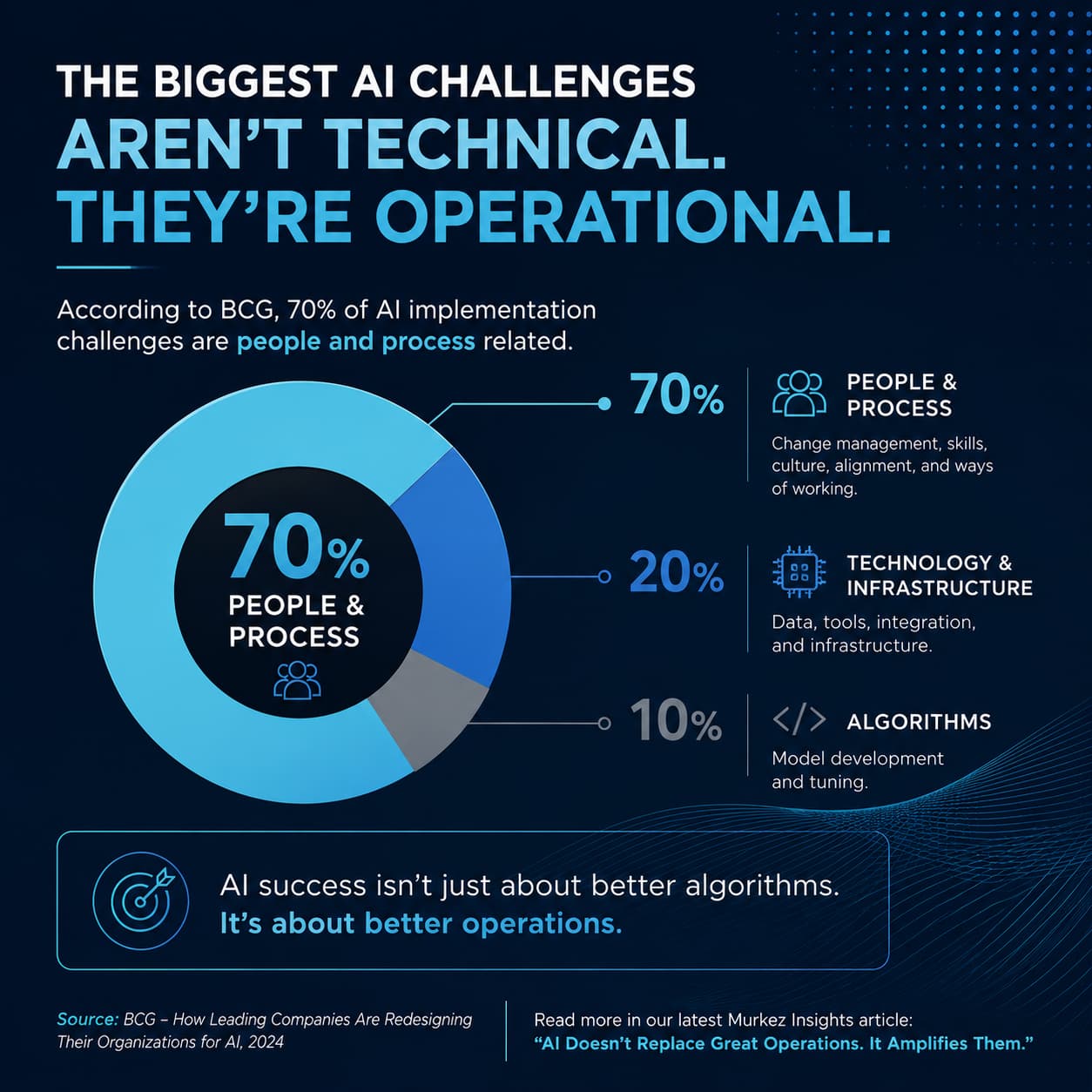
BCG’s research attributes roughly 70% of AI implementation challenges to people and processes, compared with about 20% to technology and 10% to algorithms (BCG). Corporate attention often runs in the opposite direction, with substantial energy devoted to platforms, models and architecture while workflow design, adoption, accountability and change management receive less attention.
The most sophisticated component of an AI solution may be technological. The hardest component of AI transformation is often organizational.
The operating model is where AI becomes economically interesting
At Murkez, we view business value as moving through connected layers. A business outcome is produced by an operating model. The operating model contains processes; processes contain workflows; workflows contain individual tasks.
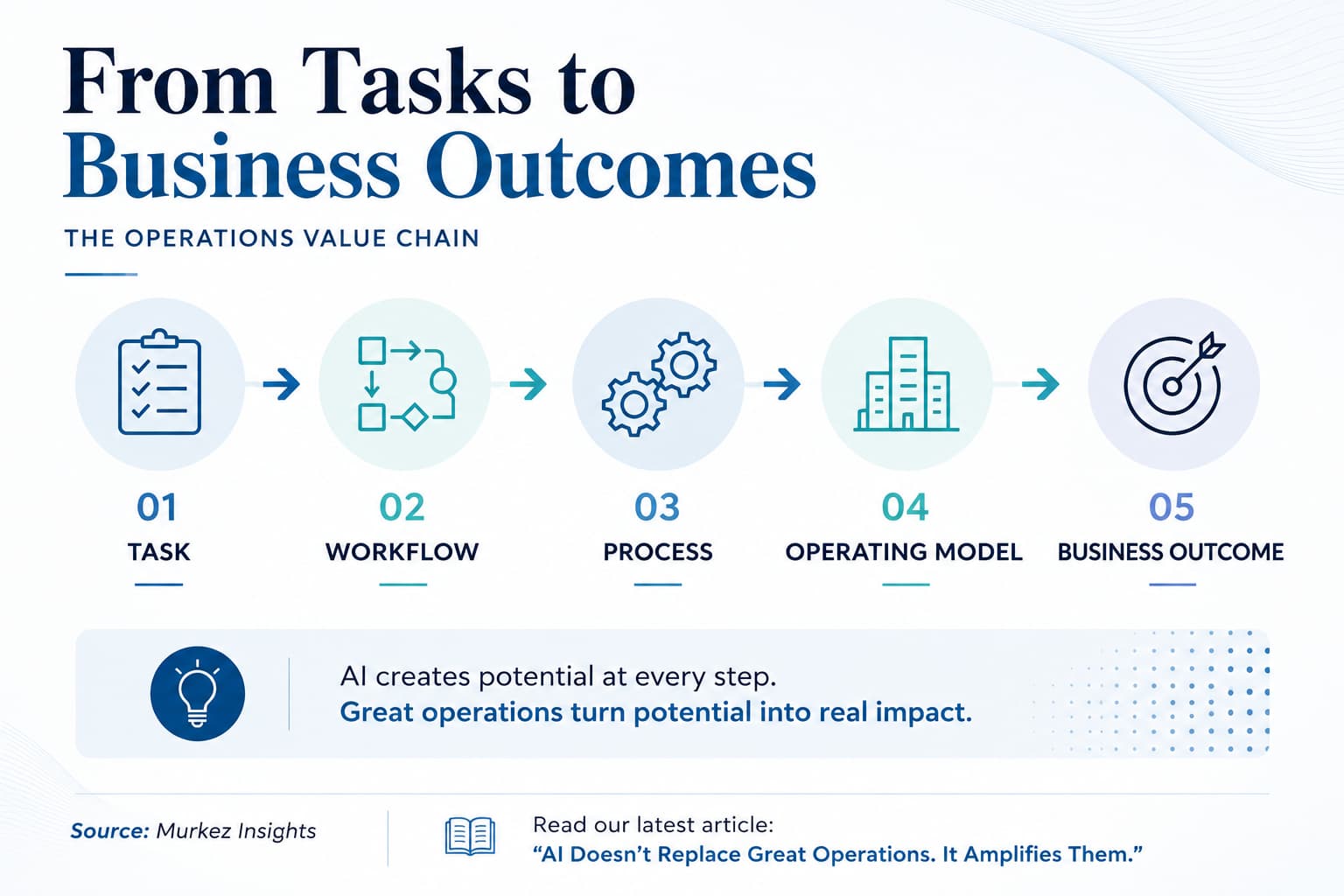
AI programs frequently begin at the task layer because tasks are easy to identify and automate. The larger opportunity appears when leadership starts with the business outcome and works backward. What result is the organization trying to change? Which operating choices produce that result? Which processes create friction? Which workflows can be redesigned now that AI can interpret, predict and act on information differently?
Take customer service. If the objective is simply to reduce average handling time, AI can help agents retrieve information and draft responses. If the objective is to improve customer resolution, the organization has to look beyond the agent’s task. Why are customers making contact? Which issues recur? How many requests require escalation? Which systems hold the information needed for resolution? What authority does the frontline employee have? Which contacts could be prevented altogether?
The first approach makes the agent faster. The second potentially redesigns customer operations. Similar logic applies across finance, HR, procurement, sales and other functions. An AI initiative becomes economically interesting when it changes the flow of work, the distribution of decisions or the capacity of the operating model, rather than merely accelerating one activity within it.
Working from the outcome backward also improves prioritization. Instead of building a long list of technically feasible use cases, leaders can focus on the small number of operating constraints that materially affect growth, cost, quality or customer experience. AI becomes part of an operating thesis rather than a collection of disconnected experiments.
AI should change exception management and the role of human judgment
One area where AI can materially reshape operations is exception management. Traditional process design handles predictable cases well and routes unusual situations to people because those cases require interpretation, judgment or context. In many organizations, however, exception handling has become a large hidden layer of work: employees investigate unusual cases, assemble information from several sources, compare precedent and decide what should happen next.
AI changes the economics of that work. It can classify exceptions, assemble relevant information, identify similar cases, estimate risk and recommend a next action. The human role can move away from information gathering and toward reviewing the recommendation, understanding context and exercising judgment where it genuinely matters.
A useful design principle is to automate the predictable, augment the ambiguous and escalate the consequential. A routine, low-risk transaction may be handled automatically. A moderately complex case may receive an AI recommendation with human approval. A high-risk exception may remain firmly under human control, with AI providing the information required for a better decision.
The distinction matters because maximum automation is not the same as optimal automation. The objective is to allocate human attention where it has the greatest economic, customer or risk value. In a mature operating model, human involvement is designed rather than inherited.
This is a more useful workforce question than asking which jobs AI can replace. The operating-model challenge is to decide where human involvement creates value and where it simply compensates for limitations that technology can now remove.
AI is changing what good jobs look like
The workforce implications are already visible in labor-market data. PwC’s 2026 Global AI Jobs Barometer, based on analysis of more than one billion job advertisements across 27 countries and territories, found that productivity growth was 40% higher at companies most exposed to AI than at the least exposed. Headcount growth was also faster at the most AI-exposed companies, 52% compared with 36% from a 2018 baseline. Skills required in the most AI-exposed jobs are changing more than twice as fast as in the least-exposed roles, while the average wage premium for specific AI skills has risen to 62%. In the US entry-level market, AI-exposed junior roles are seven times more likely to require traditionally senior capabilities such as judgment and leadership (PwC).
These findings suggest that AI is changing the composition of work, not simply its quantity. As information retrieval, routine analysis, documentation and repetitive decision support become increasingly automated, human contribution shifts toward judgment, interpretation, relationships, creativity, exception handling and accountability.
A customer-service representative supported by AI may spend less time searching for information and more time resolving difficult customer situations. A financial analyst may spend less time assembling data and more time interpreting what it means. A manager may spend less time reviewing historical reports and more time responding to predictive indicators.
Role redesign should also address a less obvious risk: if AI removes routine work without deliberately creating new learning pathways, organizations may weaken the experiences through which junior employees traditionally build judgment. The operating model has to consider not only today’s productivity but also how expertise will be developed when entry-level work changes.
Organizations should resist the temptation to bolt AI onto unchanged job descriptions. The larger opportunity is to redesign roles around comparative advantage: machines handling activities where speed, scale, pattern recognition and consistency matter most, and people concentrating on work where context, judgment, empathy and accountability create greater value.
From automation to intelligent operations
For years, operational improvement focused on standardization, digitization and automation. AI adds a new dimension because it can increasingly work with information and decisions that could not easily be encoded into deterministic rules.
An automated operation executes predefined actions efficiently. An intelligent operation can also interpret information, identify patterns, anticipate what may happen and recommend or initiate an appropriate response. The distinction moves operations from executing known rules toward continuously interpreting changing conditions.
Traditional reporting tells a manager what happened last month. Intelligent operations can help identify which accounts are likely to become problematic next week. Traditional quality control identifies errors after they occur. Intelligent operations can flag transactions with a high probability of error before completion. Traditional workforce planning responds to historical demand. Intelligent operations can continuously forecast demand and adjust resources earlier.
The deeper change is managerial. As operations become more predictive, management cadence can shift from periodic review toward targeted intervention. Leaders spend less time asking what happened and more time deciding what action to take before an issue becomes expensive. This can shorten the distance between signal and response, which is often where operational advantage is created.
The transition from reactive operations toward anticipatory operations may prove more consequential than the current focus on generative productivity tools. It is also harder for competitors to copy. A competitor can buy the same AI software; replicating an operating model built around better workflows, cleaner data, clearer decision rights and stronger organizational learning is considerably more difficult.
The real AI flywheel is operational learning
AI does not only perform work. Properly designed, it can make the operation itself easier to understand. Every process produces signals: customer requests, delays, exceptions, approvals, escalations, complaints, transaction patterns and employee interventions. Much of this information has historically been difficult to analyze because it is fragmented or unstructured.
AI can make those signals more visible, creating an operational learning loop. The organization observes how work is being performed, identifies patterns and friction, redesigns the workflow, measures the outcome and uses the resulting information to improve the next iteration.
A strong learning loop also changes the role of process governance. Instead of treating process design as something that is reviewed only during a transformation program, teams can use operational evidence to make smaller and more frequent adjustments. The operating model becomes more responsive because it can detect where reality has moved away from the process that was originally designed.
Traditional process improvement is often episodic: a transformation program maps the process, implements changes and eventually concludes. Intelligent operations can make improvement more continuous. The operating model becomes capable of learning from its own activity.
The most valuable AI system may be one that does more than execute a process. It helps the organization continuously understand and redesign that process.
A more disciplined approach to AI investment
The urgency surrounding AI can encourage organizations to pursue large numbers of initiatives at once. BCG’s research found that AI leaders concentrate on fewer, higher-priority opportunities. These leaders pursue roughly half as many opportunities as less advanced organizations while successfully scaling more than twice as many AI products and services. Over the preceding three years, AI leaders in BCG’s analysis achieved 1.5 times higher revenue growth, 1.6 times greater shareholder returns and 1.4 times higher returns on invested capital (BCG).
The lesson is not simply to run fewer projects. It is to distinguish between experiments designed to build organizational learning and investments expected to produce measurable business value. The second category should be governed with the same discipline as any other operating investment.
Leadership should be able to answer a small number of demanding questions. What outcome are we trying to improve? Which workflow produces that outcome? Where does it lose time, money or quality? What should be eliminated before technology is introduced? Where can AI create disproportionate leverage? What role should remain human? How will the resulting capacity or performance improvement be captured?
If those questions cannot be answered, the organization may not yet have an AI business case. It may simply have an AI use case.
Why pilots fail even when the technology works
AI projects do not necessarily fail because the model performs poorly. They can fail because the surrounding system was never prepared to convert technical capability into operational value.
Gartner originally predicted that at least 30% of generative AI projects would be abandoned after proof of concept by the end of 2025 because of poor data quality, inadequate risk controls, escalating costs or unclear business value (Gartner). Its subsequent assessment published in January 2026 was more sobering, reporting that by the end of 2025 at least 50% of generative AI projects had been abandoned after proof of concept for these reasons (Gartner).
A technically successful proof of concept answers whether something can work. It does not establish whether it can be integrated economically, governed responsibly, adopted by employees and scaled across the organization. The gap between pilot and production is often an absorption problem disguised as a technology problem.
Scaling requires changes that are easy to underestimate during a pilot: stable data access, process ownership, exception handling, monitoring, user adoption, controls, integration with downstream work and clarity about who is accountable when the system produces an unexpected result. A demonstration can avoid many of these constraints. An operating model cannot.
The difficult work begins after the demonstration succeeds.
The Murkez view: operational intelligence will matter more than AI access
AI capability will continue to improve, and access will become less distinctive as sophisticated functionality is embedded into the systems businesses already use. Competitive advantage will depend increasingly on what organizations are capable of changing around that technology.
At Murkez, we believe this makes operational excellence more important, not less. AI magnifies the characteristics of the system into which it is introduced. In a well-designed operation, it can accelerate information flow, increase capacity, improve consistency, support better decisions and make the organization more adaptive. In a poorly designed operation, it can accelerate unnecessary work, add another layer to fragmented technology and create more output without improving outcomes.
The next stage of enterprise AI is about intelligent operations: operating models in which technology and people each perform the work they are best equipped to do, information moves with less friction, decisions occur at the appropriate level and the organization learns continuously from its own activity.
A useful leadership question is: How would we design this business if today’s AI capabilities had existed when our operating model was first created?
Murkez helps organizations answer that question by redesigning the processes, workflows and operating structures needed to turn AI capability into measurable business value.
References
McKinsey & Company – The State of AI: Global Survey 2025
Boston Consulting Group – Where’s the Value in AI?
Boston Consulting Group – AI Adoption in 2024: 74% of Companies Struggle to Achieve and Scale Value