
Digital transformation has become one of business’s most familiar ambitions – and one of its most persistent sources of disappointment.
Organizations migrate to the cloud, replace core systems, automate workflows, deploy analytics platforms and introduce AI. The technology changes. The business often does not.
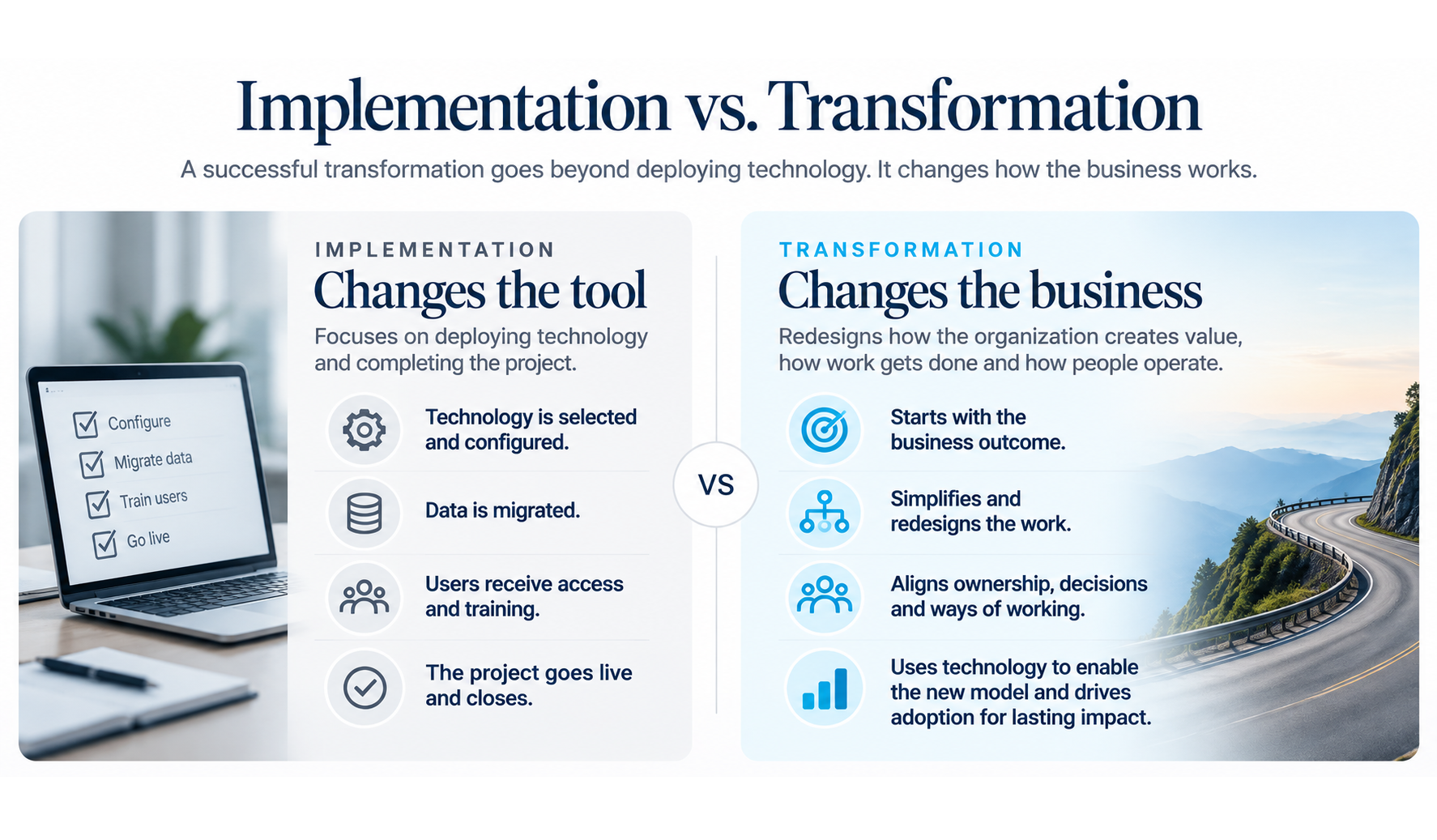
At Murkez, we see the problem as a confusion between implementation and transformation. Implementation changes the tool. Transformation changes how the organization creates value, how work gets done, who owns outcomes and how decisions are made.
That is why our approach follows a deliberate sequence:
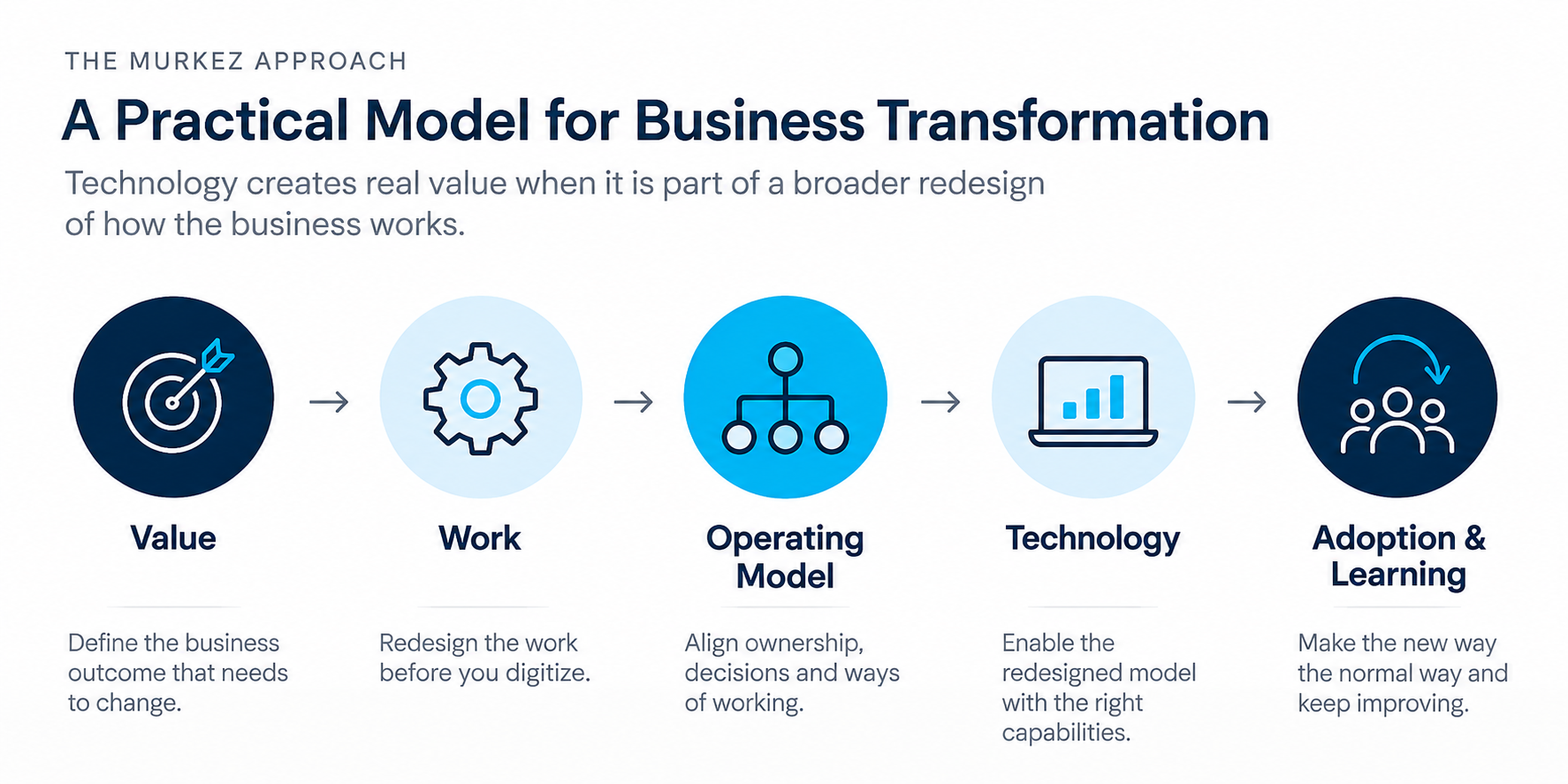
Start in the middle – with a platform, AI use case or automation target and an organization risks digitizing the business it already has. Start with value, and technology becomes part of a broader redesign of how the business should work.
Value: Start with the business problem
Technology vendors naturally organize the world around products. Businesses should not. Before selecting a platform or defining a technology roadmap, leadership should be able to answer a more fundamental question: What business outcome needs to change?
Reduce customer onboarding time. Improve forecast accuracy. Lower the cost of serving a customer. Reduce rework. Increase employee capacity.
These are transformation outcomes. “Implement platform X” is not.
Transformation programs frequently reverse this sequence. A system is selected first, requirements are gathered around it, and processes are redesigned according to what the technology can support. The result may be a technically successful implementation with limited business impact.
Deloitte’s research on digital operating models reinforces the importance of this distinction. Organizations can invest heavily in digital capability, but value realization still depends on choices around ownership, organization design and team capabilities.
At Murkez, this is the first test of a transformation program: can the organization explain, in plain language, what will be different for the business if the program succeeds? If the answer is unclear, the technology discussion has started too early.
Work: Redesign before you digitize
Once the outcome is clear, the next question is how work currently produces or prevents that outcome. Most organizations accumulate complexity gradually. Processes gain approvals. Teams build workarounds. Temporary spreadsheets become permanent. Applications are added without retiring old ones. Data is re-entered because systems do not connect. Exceptions escalate to managers. Very little of this complexity was deliberately designed. Digital transformation can expose these problems. It can also preserve them remarkably well.
A workflow with twelve steps, four handoffs and three approvals can be digitized. Information can move faster and visibility can improve. But if half those steps should not exist, the organization has not transformed the process. It has simply made the existing process more efficient.
This is the implementation trap: measuring progress by what has been deployed rather than by what has changed. A system going live is implementation. A process becoming materially simpler is transformation. This distinction applies equally to AI. Adding an AI assistant to an inefficient workflow does not necessarily improve the workflow. It may simply accelerate parts of a process that should have been redesigned first.
Do not digitize the business you have before deciding whether it is the business you need.
McKinsey documented this challenge during Johnson & Johnson’s technology operating-model transformation. In some cases, information moved through more than six handoffs before reaching the engineer responsible for the issue. The response was not simply better workflow technology. The organization moved toward cross-functional teams built around products and outcomes.
The opportunity in digital transformation is therefore larger than automation. It is the opportunity to reconsider the work itself.
Operating Model: Make the business capable of working differently
Redesigned work needs an operating model that can support it. This is where many transformation programs weaken. The technology changes, and perhaps the process changes, but ownership, governance, decision rights and management routines remain largely intact. Technology can enable a better operating model. It cannot choose one.
For Murkez, operating-model design means answering practical questions: Who owns the outcome? Where should decisions sit? Which teams need to work together continuously? What information and measures should be shared across the flow of work?
These questions matter because customers rarely experience a business through its organizational structure. A customer journey may move through sales, compliance, finance, operations and support. Every department can perform its own tasks efficiently while the overall experience remains slow. Many operational problems live between functions: a failed handoff, a delayed decision, duplicate data entry, conflicting definitions or an issue that nobody clearly owns.
This is why transformation cannot be treated as an IT project. Technology teams bring essential expertise in architecture, integration, data, cybersecurity and platforms. But if the objective is to change customer experience, productivity, financial performance or operational speed, business leaders must also own the outcome.
One person may own the platform. Someone must also own the value.
Technology: Enable the redesigned model
Only after value, work and the operating model are understood should technology become the center of the solution. That does not make technology less important. It makes technology more useful.
The question shifts from “What can this platform do?” to “What capability does the redesigned business require?”
The answer may involve automation, data, integration, workflow orchestration, analytics, a new core platform or AI.
The same principle applies to AI adoption. AI can reduce repetitive work, synthesize information, support decisions and make knowledge more accessible. But it cannot compensate for fundamental operating weaknesses. If ownership is unclear, AI does not create ownership. If unnecessary steps remain in a process, AI can execute unnecessary work faster. If underlying data is unreliable, AI can make unreliable information easier to distribute.
That is why Practical AI at Murkez begins with the work, not the model.
Understand the work. Improve the work. Then apply AI where it can remove friction, strengthen decisions or create meaningful operating capacity.
Recent McKinsey research on AI operating models points to the same underlying issue: technology creates greater value when organizations make deliberate changes to the operating model around it. The technology may be new. The management challenge is not.
Adoption & Learning: Make the new way the normal way
Transformation does not end at go-live. A platform can be deployed successfully while employees continue using old spreadsheets, duplicating information, relying on familiar workarounds or escalating decisions through the same channels as before. That is why adoption cannot be treated as a communications exercise at the end of implementation. Adoption is part of the design.
If the new workflow is harder than the one it replaces, training will not solve the underlying problem. If managers continue rewarding old behaviors, employees will follow the incentives rather than the transformation plan. The objective is not simply to make people use a new system. It is to make the new way of working better than the old one.
Traditional project measures requirements completed, testing passed, training delivered, go-live achieved remain useful for managing implementation. They say much less about whether transformation has occurred. A stronger view connects three layers: Adoption: Are people working differently? Operational performance: Is the process actually better? Business outcomes: Is the organization capturing the value it expected?
A system can have high adoption and limited business impact. A process can become faster while producing a worse customer experience. Reported savings may never appear in financial performance. Transformation therefore requires continuous learning as well as measurement. Technology changes. Customer expectations change. Market conditions change. A fixed multiyear transformation plan can become outdated before it is complete. Organizations need shorter implementation cycles, frontline feedback, operating data and disciplined review so they can adapt as evidence emerges.
The long-term goal is not simply to complete a transformation. It is to become better at transforming.
Transformation is an operating discipline
The technologies will keep changing. Cloud platforms were followed by automation, advanced analytics and AI. The next generation of capabilities will arrive faster still. The underlying challenge remains remarkably consistent. Companies create value from technology when they connect it to business outcomes, redesign the work around those outcomes, build an operating model capable of supporting the change and embed the new way of working into the organization.
That is why the sequence matters:
Value → Work → Operating Model → Technology → Adoption & Learning
Implementation asks whether the technology works. Transformation asks whether the business works differently because of it. At Murkez, that is the standard for business transformation. Technology is essential to the journey, but it is not the transformation itself.
The real work is redesigning the business around what becomes possible.
References
- Deloitte – Digital Operating Models: Five Leadership and Teaming Choices That Can Help Drive Increased Value
- McKinsey & Company – Transforming the Corporate Technology Operating Model
- McKinsey & Company – The Key to AI Value Is Hiding in Plain Sight: Your Operating Model